What YouTube means by “reused content”
YouTube's monetisation policy says it plainly: channels that upload content taken from other sources “with little or no educational value or original commentary” are not eligible for the Partner Programme. It doesn't matter if you edited the video yourself: if the content adds nothing of your own, it doesn't monetise.
In July 2025 YouTube renamed its “repetitive content” policy to “inauthentic content” to make clear it covers mass-produced or repetitive output. The reuse policy didn't change: it still looks at commentary, clips, compilations and reactions.
“Channels that upload content taken from other sources with little or no educational value or original commentary are not eligible for the YouTube Partner Programme” — YouTube channel monetization policies.
How it ends in a strike (and how much it hurts)
YouTube's strike policy is tiered, and the timing matters:
- First violation: usually just a warning. You can take an optional training; the warning expires 90 days after you complete it.
- First strike: you can't publish for 1 week. The strike stays on the channel for 90 days.
- Second strike within those 90 days: 2 weeks without publishing.
- Third strike in the same period: the channel can be permanently removed from YouTube.
And mind two details almost nobody reads: deleting the video doesn't remove the strike, and a single case of severe abuse can end the channel with no prior warning.
“But my script is original”
Here's the mistake almost every faceless channel makes. The policy doesn't ask who typed the text: it asks whether the video adds something. These three patterns read as reuse even if the script is yours:
- The same skeleton: hook intro → context → 5 facts → conclusion, copied from the video that works in your niche.
- The same facts in the same order: the recycled top-10 that's already on twenty channels, told the same way.
- Generic narration: a text any channel in the niche could voice without changing a comma. If you swap the channel name and nobody notices, there's no angle of your own.
Rewriting with synonyms doesn't turn reused content into original. What makes a video eligible is analysis, commentary and an angle of your own — exactly what the policy calls educational or commentary value.
What YouTube allows and what it doesn't
The monetisation policy page carries two lists of examples, both marked “not exhaustive”. They're not open to interpretation: they're the cases the reviewer has in front of them when they open your channel.
| Can be monetised | Can't be monetised |
|---|---|
| Clips that add context to a review or critique | Clips from a show compiled with no added narrative |
| A movie scene with the script and voice-over rewritten | Compilations of short videos from other social platforms |
| Sports replays where you explain the winning moves | Compilations of songs from several artists, even with their permission |
| Reaction videos where you talk about the original content | Videos that many other creators have already uploaded |
| Other creators' footage edited with a new script and commentary | Content downloaded or copied with no substantive changes |
| Content where the creator appears or explains what they added | Reactions with no spoken commentary |
Source: YouTube channel monetization policies (accessed 23/11/2026). A case missing from the left column isn't safe: both lists are examples, not the full text of the rule.
What the reviewer actually looks at
For reused content, YouTube says its reviewers check how you created the content or how you took part in it, and names four places to look:
- the videos,
- the channel description,
- video titles,
- video descriptions.
When it reviews the channel as a whole, the list grows to six: main topic, most-viewed videos, most recent videos, videos with the highest share of watch time, video metadata (titles, thumbnails and descriptions) and the channel's “About” section.
Two consequences a faceless channel usually misses:
- The channel description counts. Empty, copied or generic is one more signal pointing the same way as the video.
- The review is of the channel, not of one video. Verbatim: “if you have videos that violate our policies or we can't clearly confirm you created the content, monetisation may be disabled across your entire channel”.
If you're rejected: the deadlines that are written down
There's no room for interpretation here, and almost nobody has these straight. All of them come from official help pages:
| Situation | Deadline |
|---|---|
| First YPP application rejection | 30 days from the email to reapply |
| Repeated rejection or application already resubmitted | 90 days from the email |
| You think the rejection is a mistake | 21 days to appeal |
| Scheduled channel suspension | 7 days' notice before suspension, with the option to appeal |
| Appeal submitted | Answer within 14 days; if accepted, approval within 30 days |
| Appeal rejected | 90 days from the suspension or rejection to reapply |
Sources: FAQ: channels whose monetization has been rejected and Appeal your channel's YPP suspension (accessed 23/11/2026).
Three cases, and what saves them
The three formats that fall most often in faceless channels, and what changes the outcome:
1. Reddit stories read aloud
Why it falls: it's a reading of material you didn't write, and the policy names that category explicitly. Changing the title or adding music doesn't touch the substance.
What saves it: treating the case as material for analysis —what decision was made, what went wrong, what you'd have done differently— in your own voice. If the video stands without the original thread, there's work of your own.
2. Movie recap with clips
Why it falls: clips plus narration describing what's already on screen. The viewer gains nothing they didn't have in front of them.
What saves it: a script that interprets: why the scene works, what changed from the book, what was cut in the edit. The official list allows exactly that — a scene with a rewritten script and voice, substantive editing with effects of your own.
3. The niche's recycled top-10
Why it falls: same facts in the same order, no angle. It's the pattern the policy calls generic or repetitive, and that one is reviewed separately from reused content.
What saves it: your own dated data, an order that follows your own criterion and a conclusion that isn't already in the other twenty videos. If you swap the channel name and nobody notices, there's nothing there.
Where it's really decided: in the script
The strike doesn't start in the video editor. It starts when you decide to tell “the same as the 2-million-view video, but in my voice”. For a faceless channel that's a coin flip: the same pattern that gives you easy views is the one that takes you out of monetisation.
The useful question before recording isn't “does it look like another video?”, it's: what do I say here that hasn't been said, with what data and from what angle? If there's no answer in one sentence, the script isn't ready.
How TEXT-XL applies it
TEXT-XL works the opposite way to a generic text generator: each channel is a project with its context and rules, and the script is written with the policy inside. Before publishing, the risk warning shows up in the script itself, not in an email a week later:
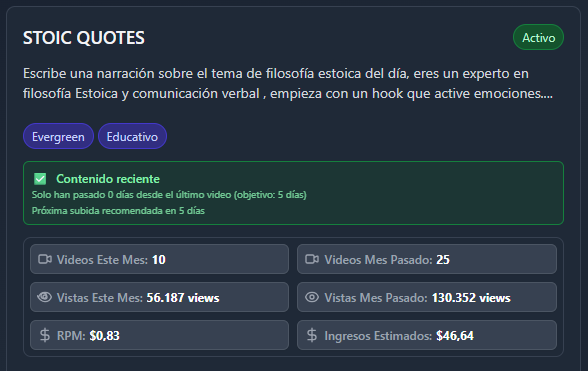
Does it guarantee zero strikes? No, and be suspicious of anyone who does: the final decision is YouTube's. What it does is make the risk visible antes recording, while changing it is still free.
Pre-publish checklist
- Does the script add analysis or commentary of its own, or just reorder what's already been said?
- Are the facts verifiable and yours, or from the same top-10 as always?
- Is there an angle no other channel in the niche has?
- Have you checked the script's risk warning (strike, inauthentic content, reuse)?
- Could you defend to YouTube why this video is original? If not, don't publish it yet.
Write the next script with the rules built in. Strike warnings before publishing, per-channel context and plans from 14.95 US$ a month.
See the plansSources: YouTube channel monetization policies · Community Guidelines strike basics · Channel terminations. Updated 23 November 2026.